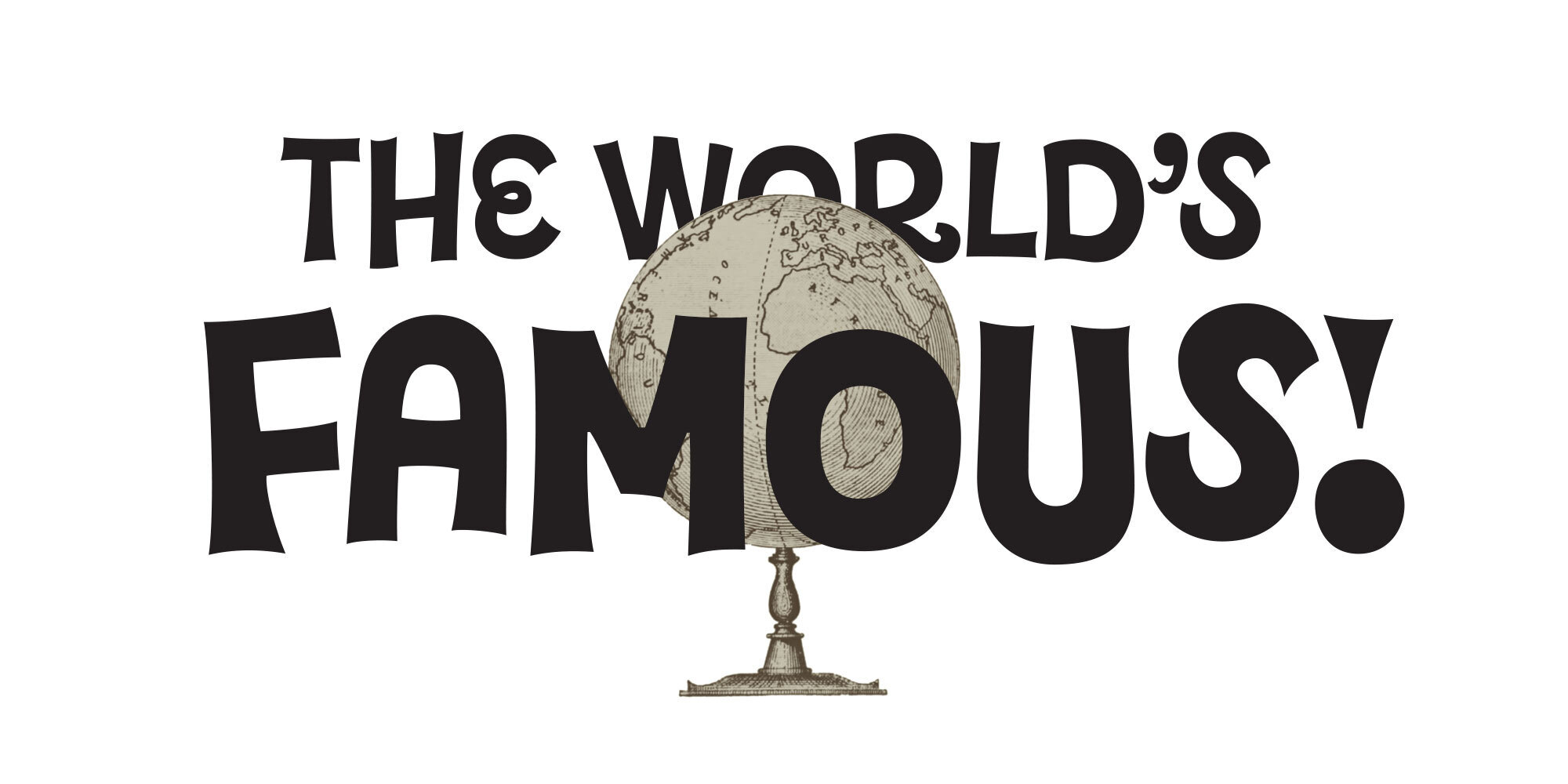
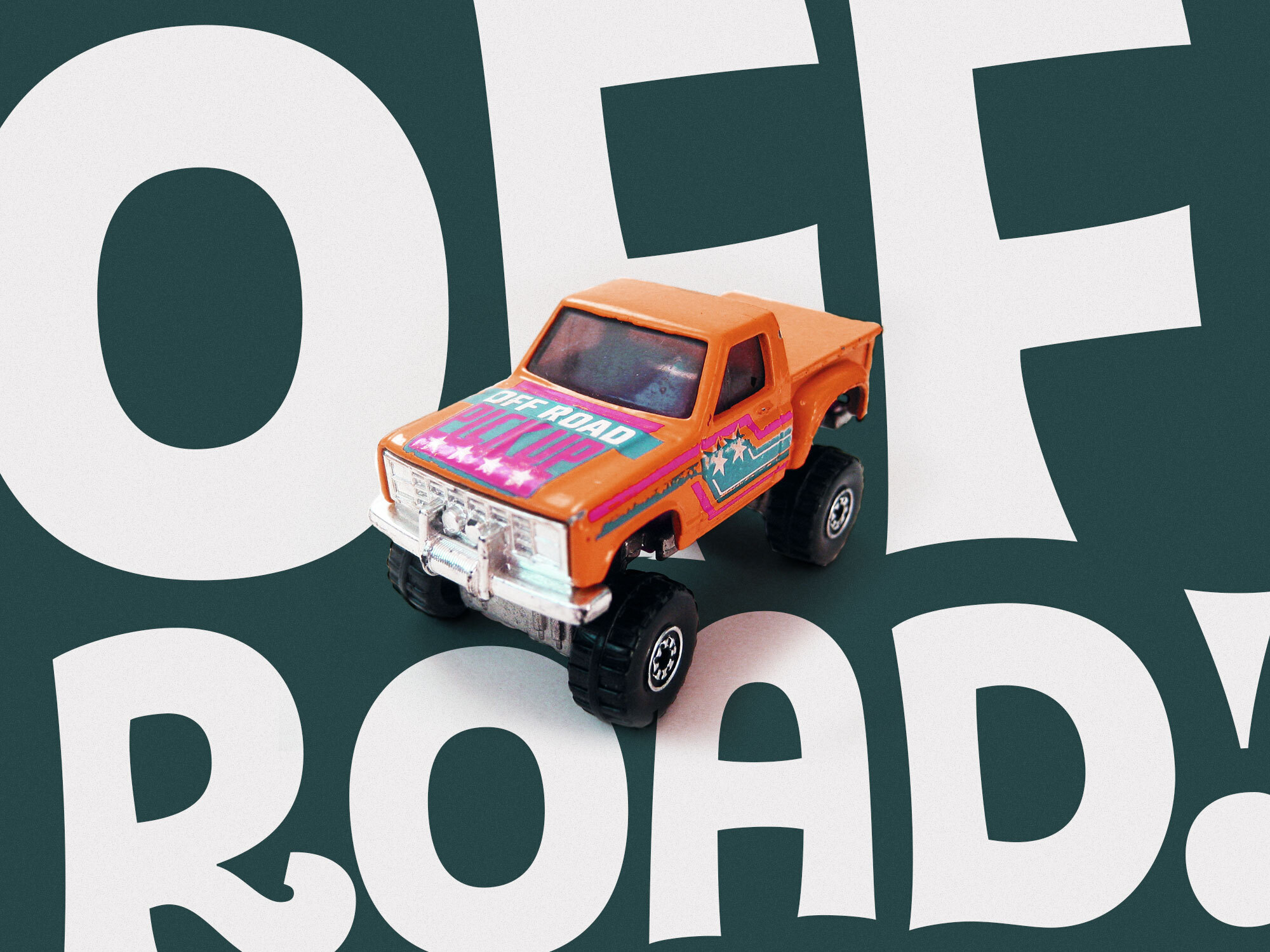
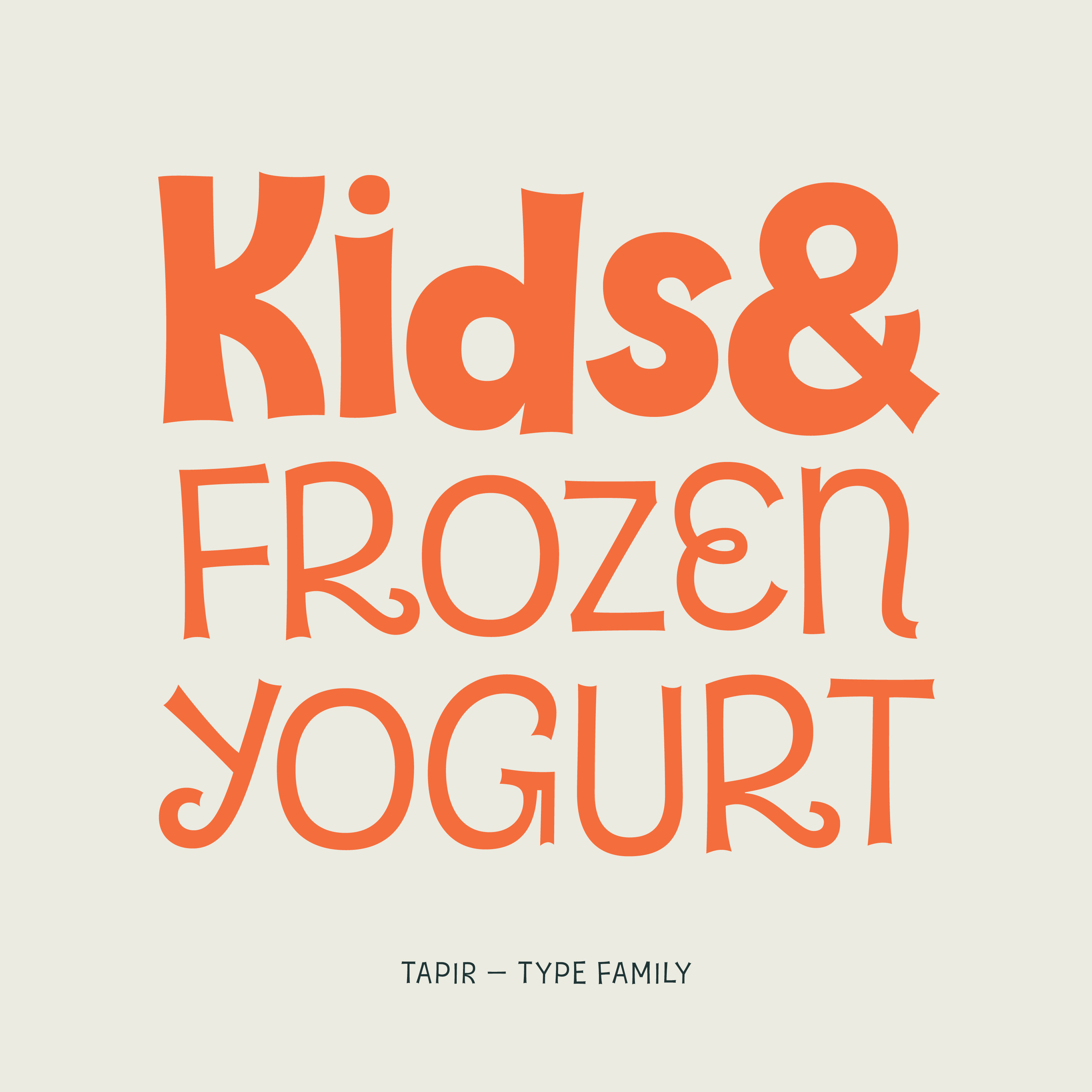
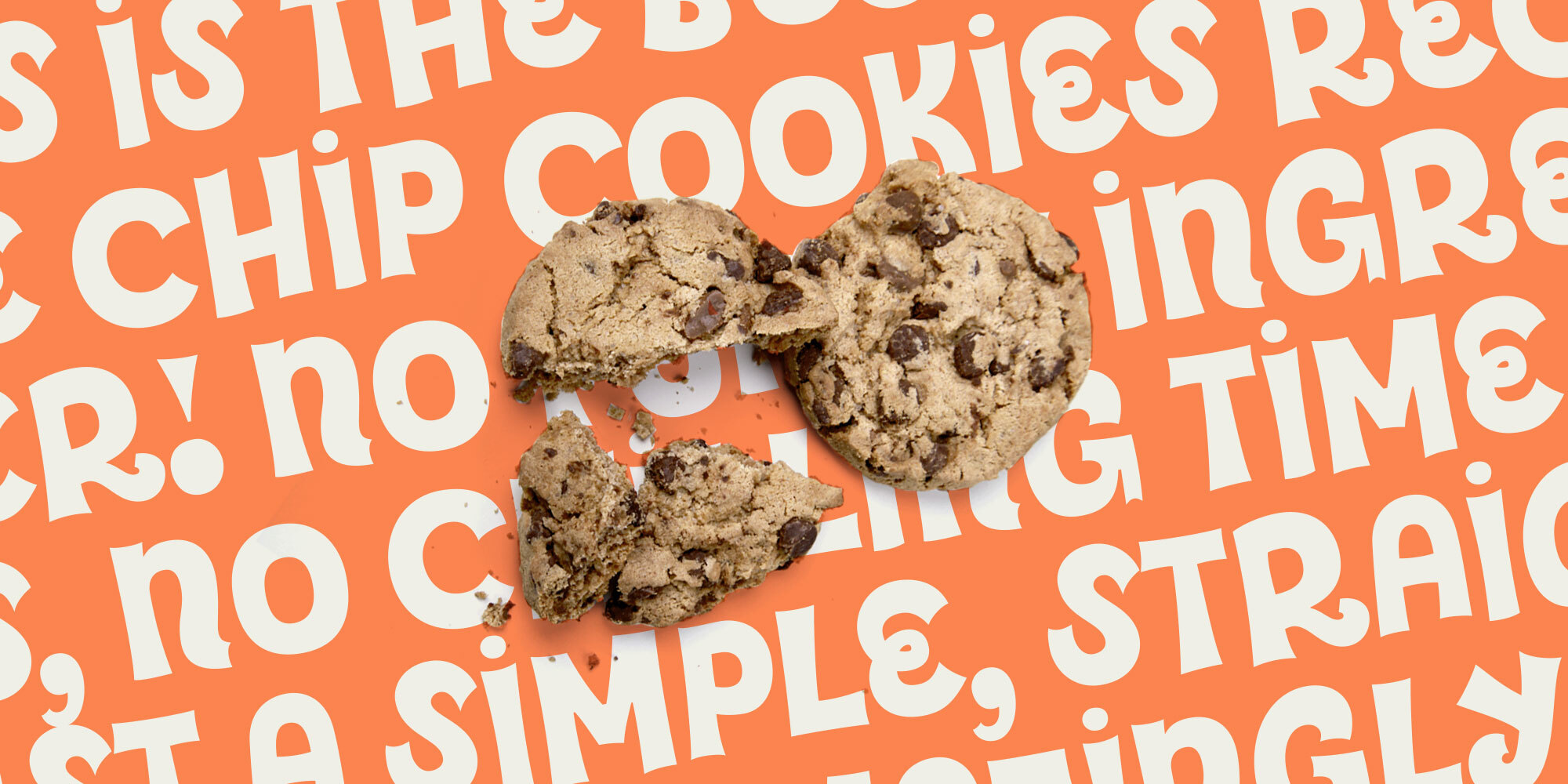
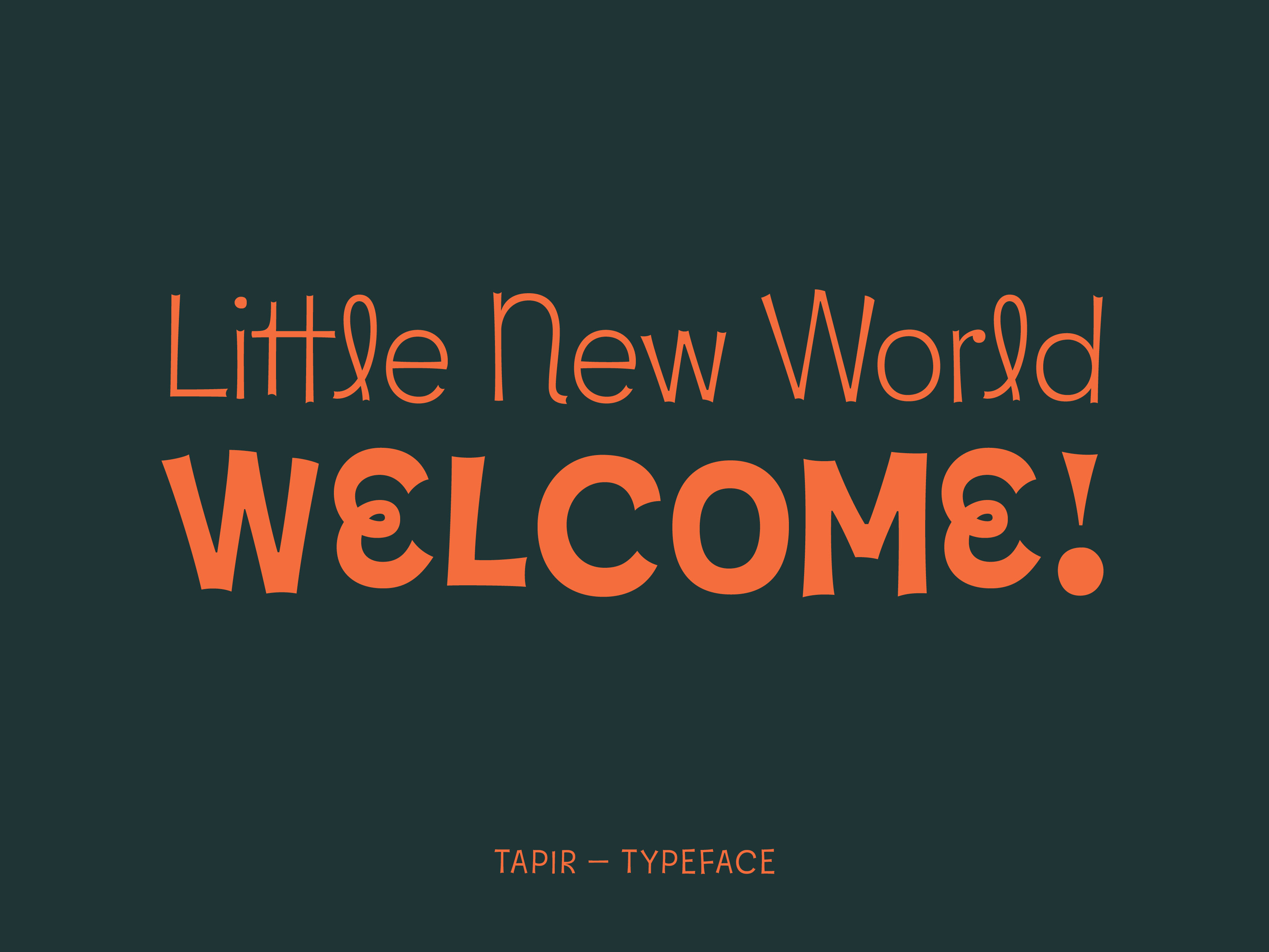
Tapir is intended to be used everywhere where a fun and unique feeling should be conveyed: Games, Food, Service or Advertising. The type family has a positive, quirky appearance and works in all different environments where attention is needed.
Designing Tapir was driven by the search for a display typeface which is doing something different than the rounded and bouncy fun faces – the letterforms should stand out with a slight touch of weirdness, creating attention and recognizabilty. A big character set, optimized spacing & kerning and lots of features make Tapir a good choice for professional usage between games, toys and skateboards.
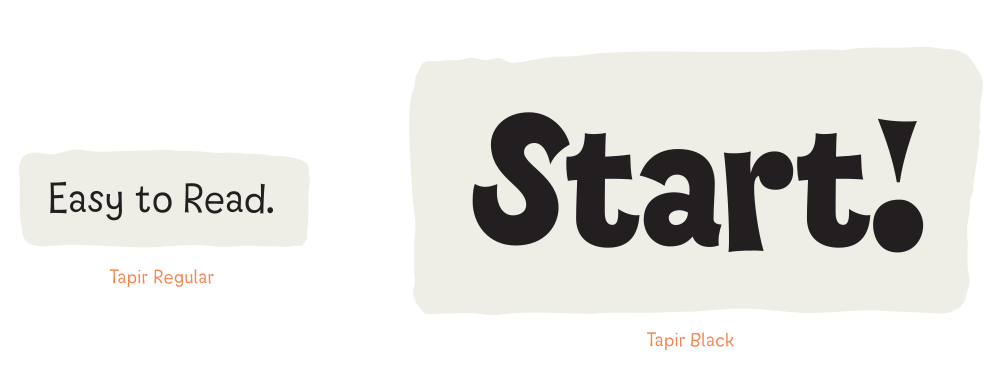
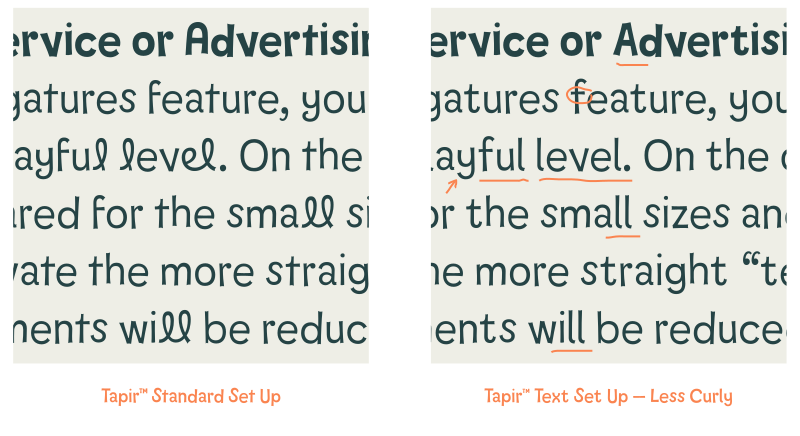
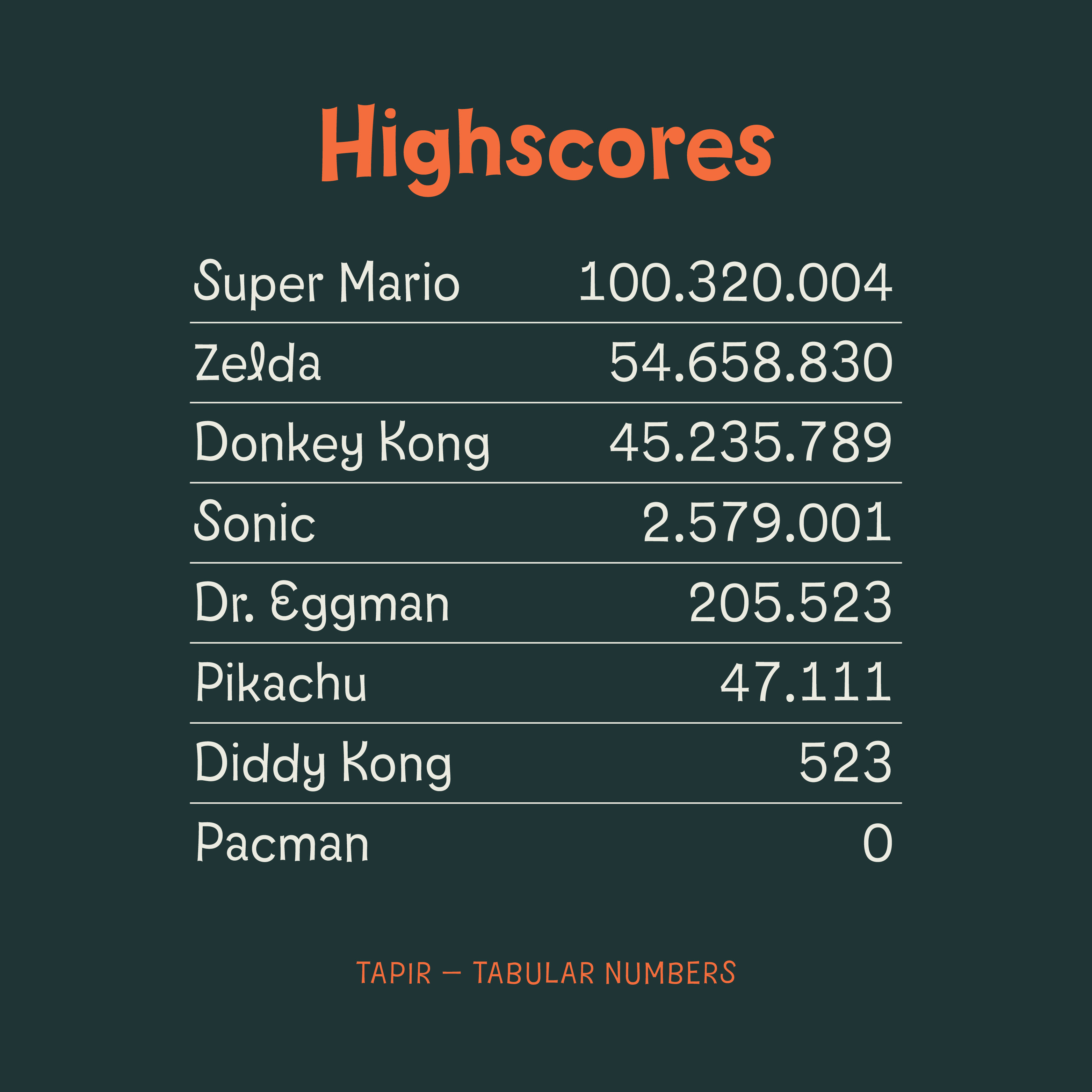
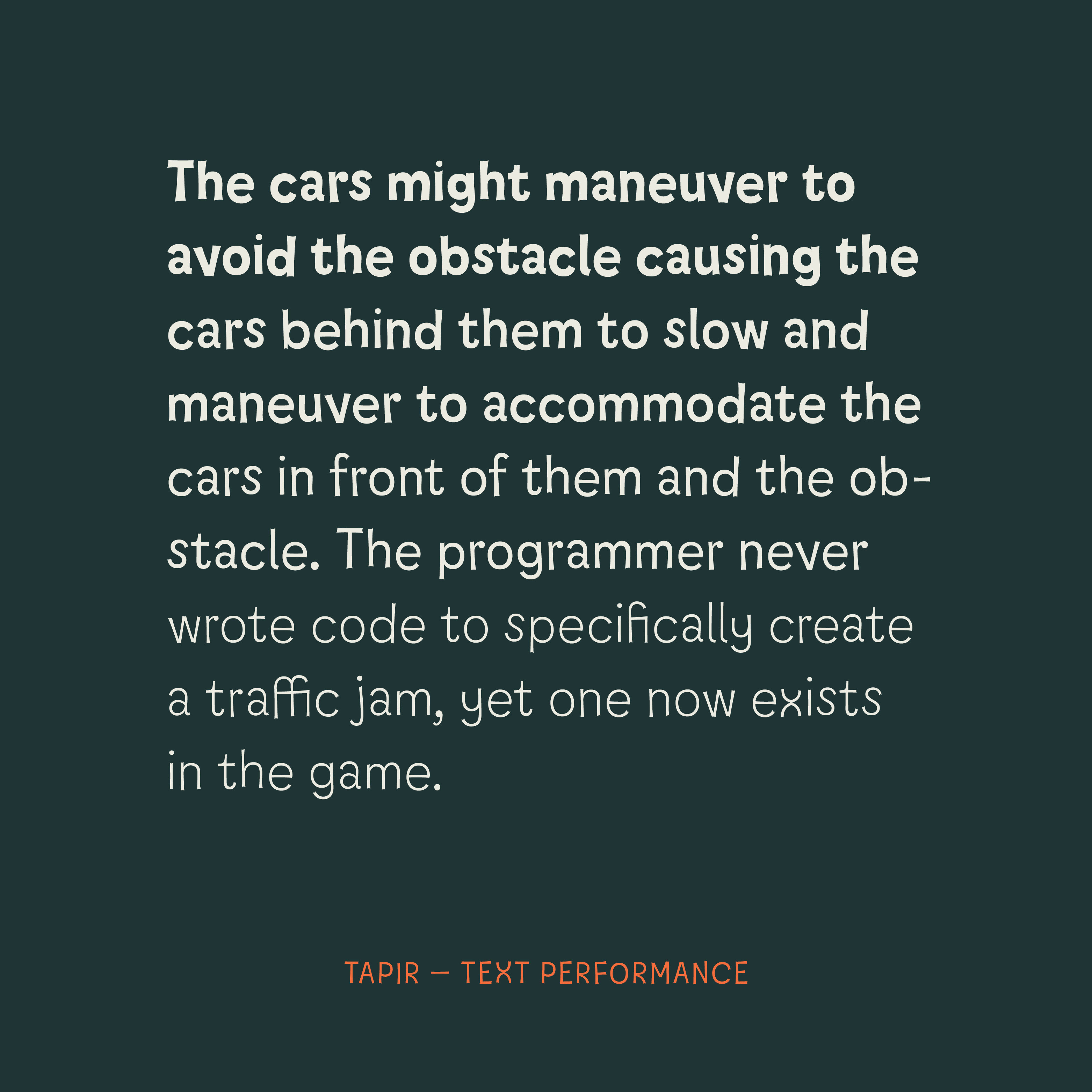
The thinner weights (Light, Regular & Medium) are designed to work even in longer texts in small sizes – especially with the simplified “Stylistic Set 1 for Text”. These weights deliver text ability, while the bolder weights are more extroverted for headlines and big uses, creating extra attention.
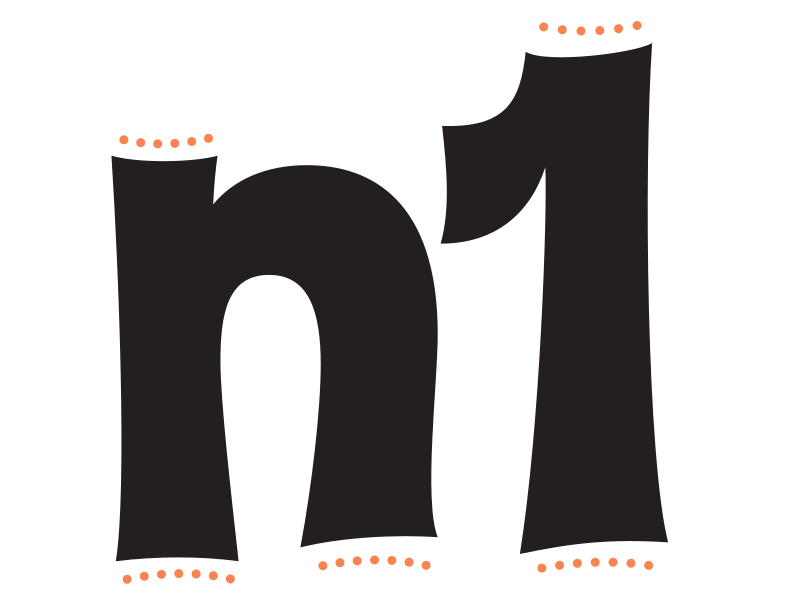
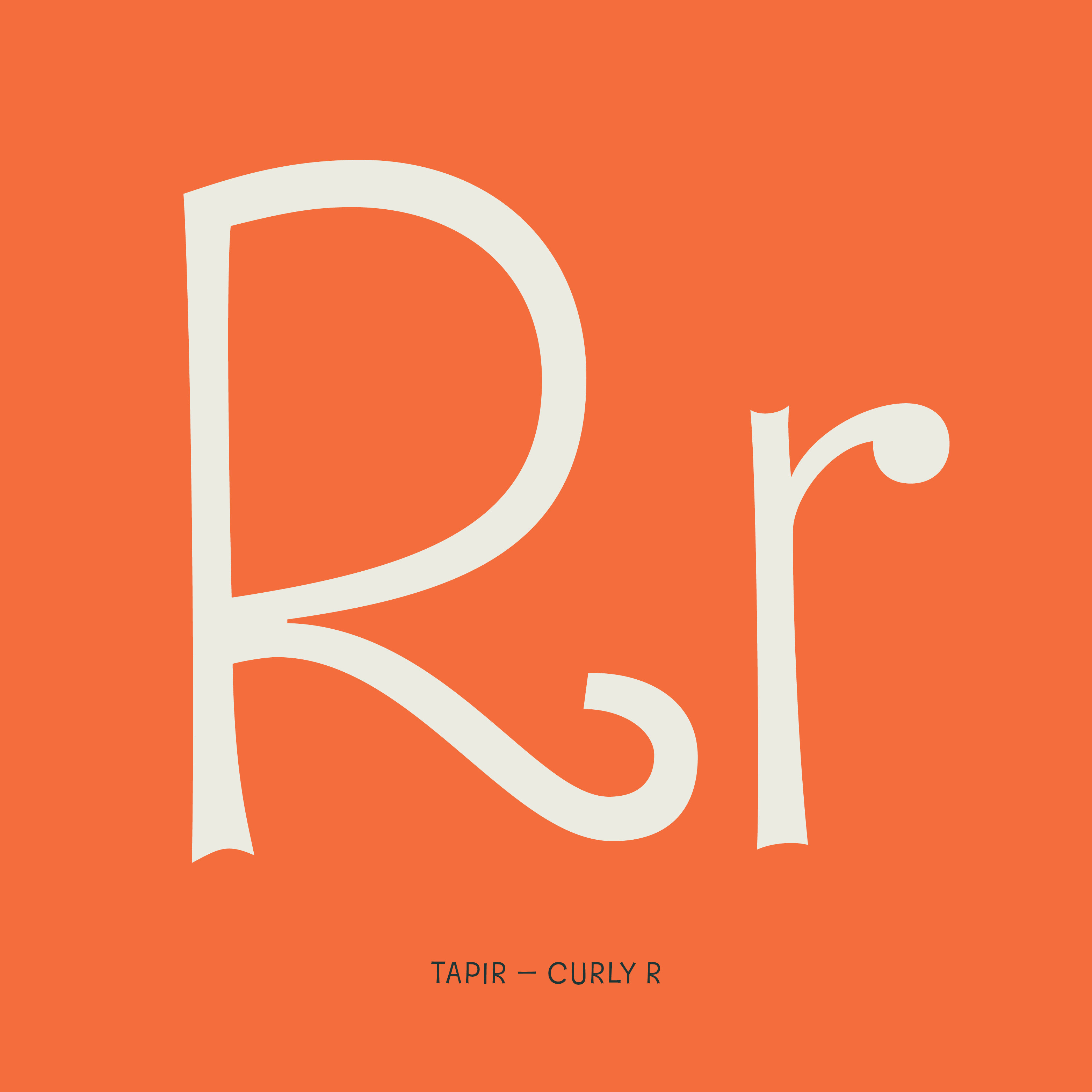
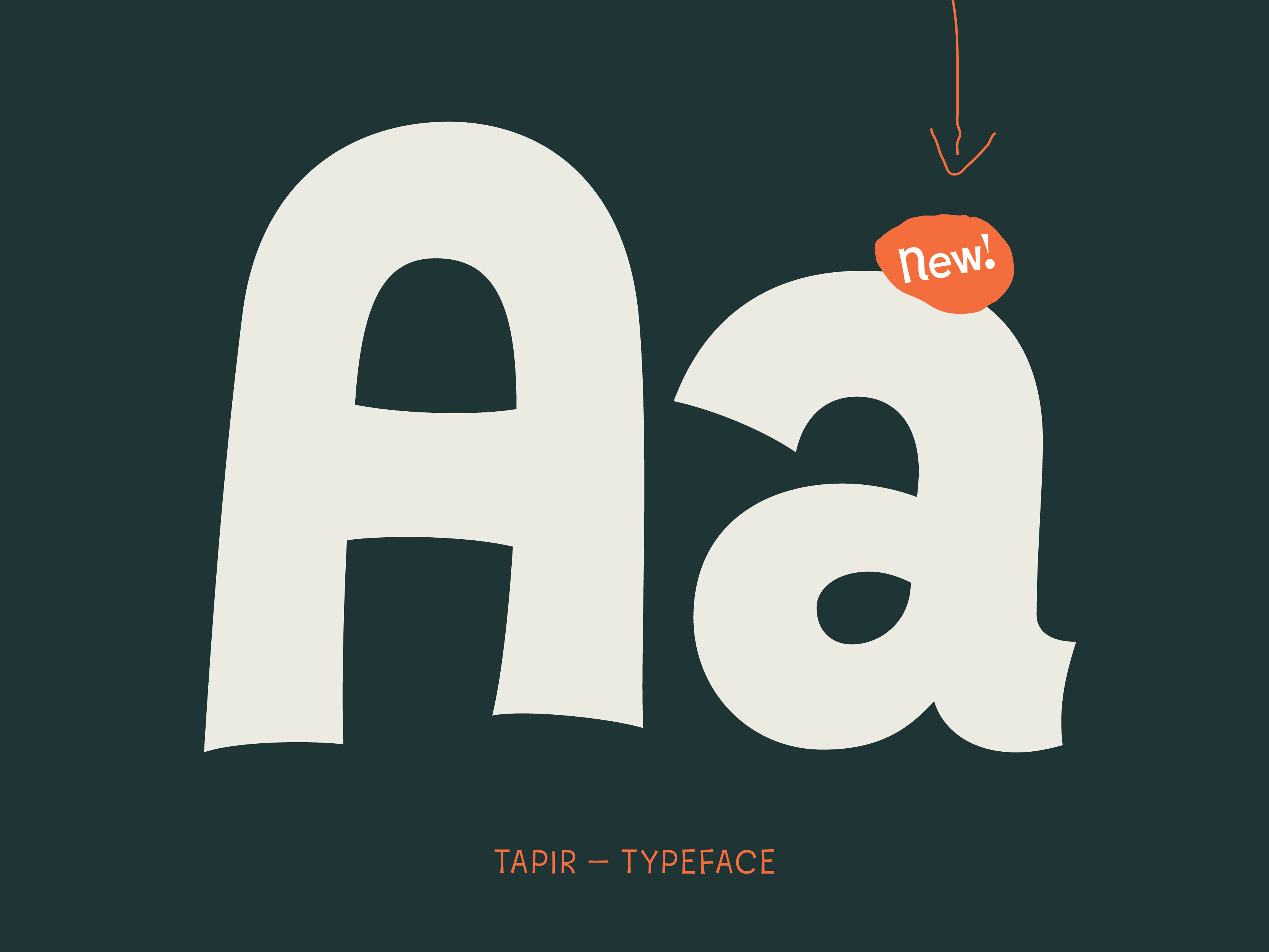
It is a challenge to draw letters with concave curves and keep a distinctive aesthetics. Sharp forms have a special character: They can quickly feel aggressive, but but we wanted to achieve a friendly and playful vibe. The stems of Tapir feel like a deflated box with spiky endings, while the architecture of the characters has a dynamic nature, quoting elements of a script face (e.g. the nose of the 1 or the different height of the stem endings).
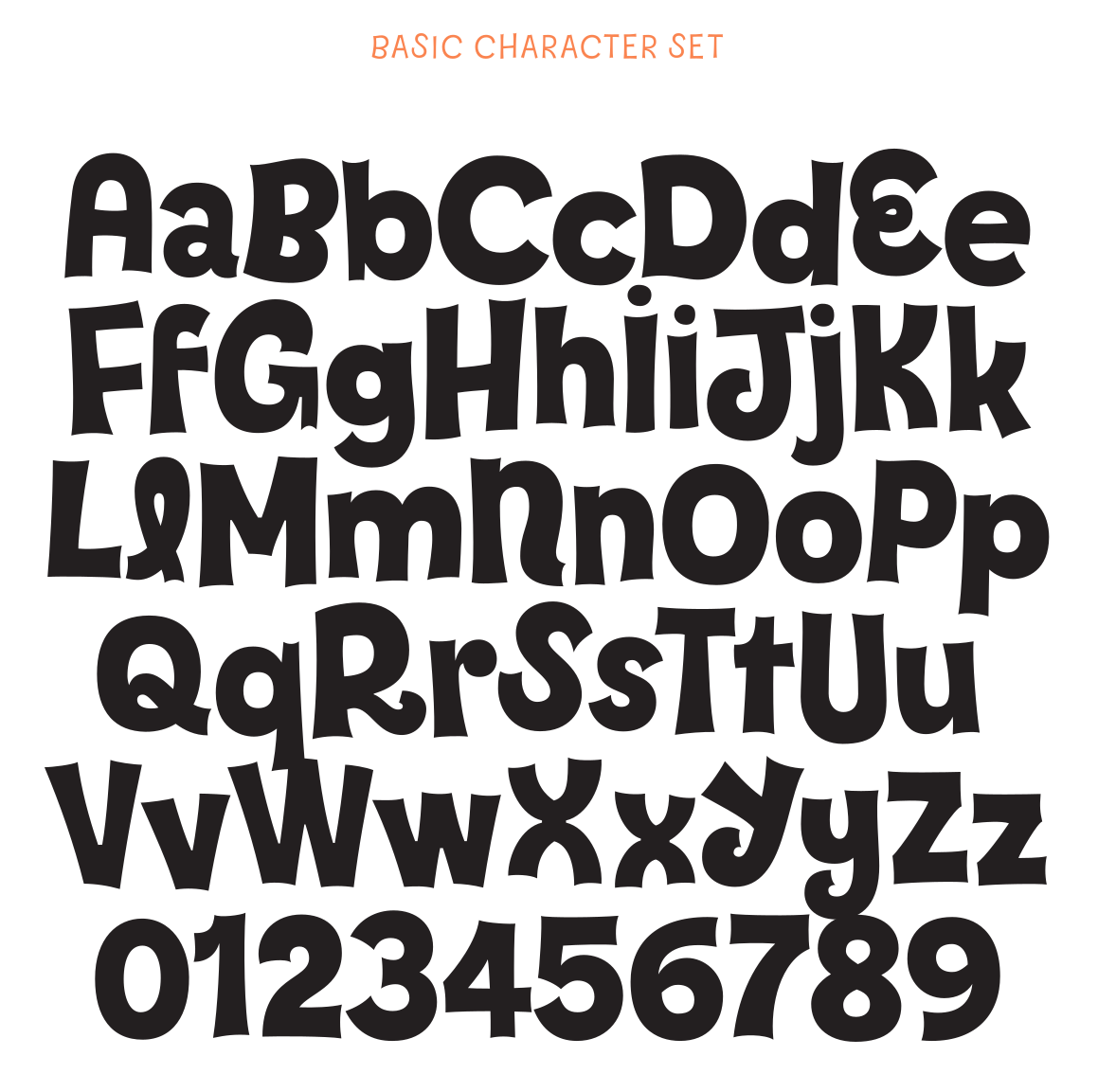
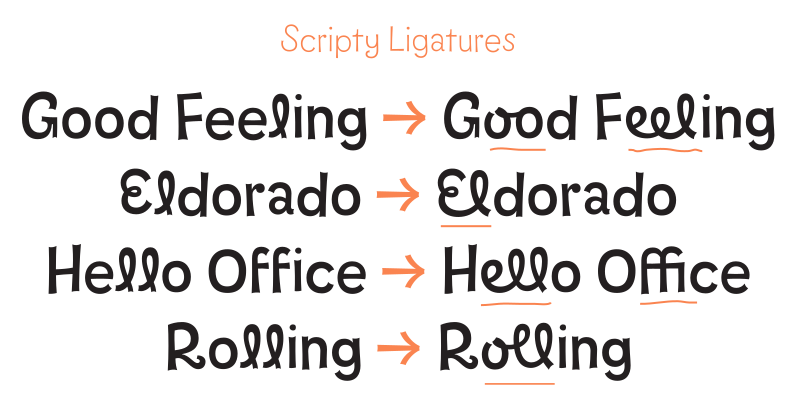
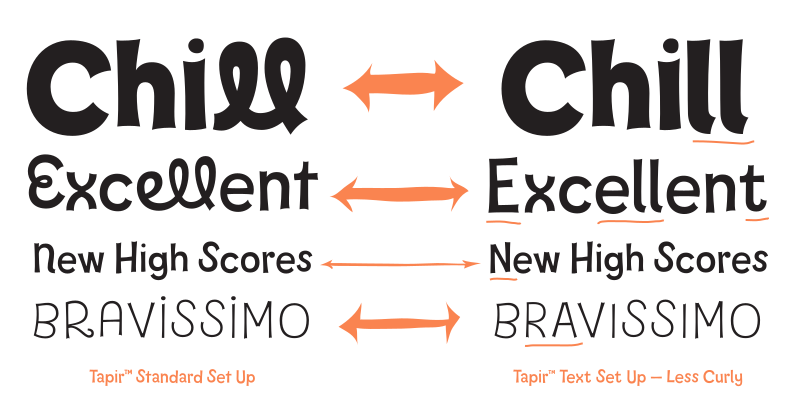
This is an overview of the basic characters of the Tapir Black weight. You can use this default set up, but you can also activate the scripty ligatures to add an even more playful and scripty appearance or you can get a less curly version e.g. for longer texts through activating the Stylistic Set 1 (Text Set Up).
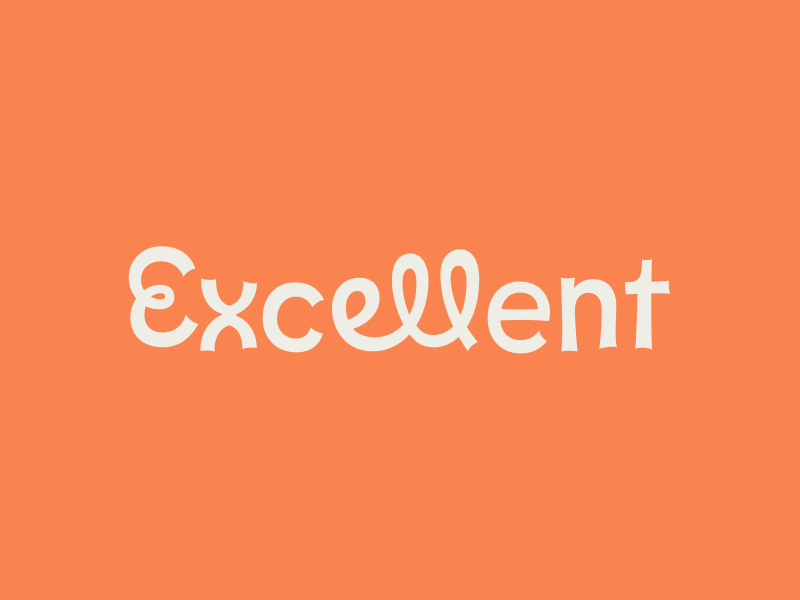
To push the look even more into the script direction, we added a big set of curly ligatures of letter combinations to the basic characters. Although the typeface works well without them, they can be activated to add another layer of quirkiness. When the ligatures are activated they create an interesting mix of connected and non connected letters resulting in a dynamic, spontaneous image.
Tapir has with a big character set supporting nearly all latin based languages + additional characters like punctuation, different sets of numerals and currency symbols. Tapir is equipped with everything a professional typeface needs.
As fun as all these curly forms are, we also needed to think about different usage fields. Big headlines and logos are covered either with curly or more straight forms, but when it comes to text passages the focus is on reading rhythm and fluid text dynamic.
It makes sense to reduce the quirkiness for these applications. The result was a set of alternate letters which are more straight than the default ones, tested in the environemt of text blocks. This text-flavoured Tapir can be activated with one click through the OpenType features (Stylistic Set 1) and is ready to perform in explanations for games or in short manuals.
A font of today’s needs has to include more than just the alphabet and some punctuation. Besides a big number of accented letters, making sure that the typeface has a good language support, a font should include several features for excellent typographic work joining forces with the layout applications of the time and of course the user. Here is a selection of what this font family has to offer under the hood.
Help!
If two letters have the nature to collide when used in combination a ligature is needed to solve this unwanted event. Ligatures are especially designed solutions for such letter combinations. This font contains a set of ligatures which are automatically substituted as soon as these letter combinations are typed in.
Woow! I finished 1/3 of this game.
If fractions are needed anywhere an OpenType code makes sure that if you type any numbers combined with a slash between a fraction will automatically be substituted.
ANGRY
Besides the standard letters a font sometimes contains several versions of a letter called alternates. You can exchange the alternate with the standard letter by selecting it through the Opentype feature panel and every letter of the stylistic set will be exchanged. Often this results in a totally different optical appearance of the typeface.
C2H4OH
A subscript is a character that is set slightly below the normal line of type. They are used in formulas, mathematical expressions, and specifications of chemical compounds and isotopes, but can have many other uses as well. These characters are not simply ordinary characters reduced in size – to keep them visually consistent with the rest of the font, they are slightly heavier than a reduced-size character would be.
The Winner!4
A superscript is a character that is set slightly above the line of type. It has the same weight and size like a subscript character. They are also used in formulas, mathematical expressions and text references, but can have many other uses as well.
Latin: Afar, Afrikaans, Albanian, Basque, Belarusian, Bislama, Bosnian, Breton, Catalan, Chamorro, Chichewa, Comorian, Croatian, Czech, Danish, Dutch, Esperanto, Estonian, Faroese, Fijian, Filipino/Tagalog, Finnish, Flemish, French, Gaelic, Gagauz, German, Gikuyu, Gilbertese/Kiribati, Haitian-Creole, Hawaiian, Hungarian, Icelandic, Indonesian, Irish, Italian, Javanese, Kashubian, Kinyarwanda, Kirundi, Latin, Latvian, Lithuanian, Luba/Ciluba/Kasai, Luxembourgish, Malagasy, Malay, Maltese, Maori, Marquesan, Moldovan/Romanian, Montenegrin, Nauruan, Ndebele, Norwegian, Oromo, Palauan/Belauan, Polish, Portuguese, Quechua, Romanian, Romansh, Sami, Samoan, Sango, Serbian, Sesotho, Setswana, Seychellois-Creole, Swazi, Silesian, Slovak, Slovenian, Somali, Sorbian, Sotho, Spanish, Swahili, Swedish, Tahitian, Tetum, Tok-Pisin, Tongan, Tsonga, Tswana, Turkish, Turkmen, Tuvaluan, Uzbek, Wallisian, Walloon, Welsh, Xhosa, Zulu.
Enjoy this typeface?